Talent Circles

Showing posts with label Talent Networks. Show all posts

Thursday, February 13, 2014

How to Optimize Your Talent Network (Part 1 of 2)


By Jessica Miller-Merrell 

In the past decade, the role of the HR professional has evolved into providing the solutions for the entire lifecycle of talent management. Beyond the hiring or firing of corporate landscape, the HR role approaches a company’s talent holistically. Integrating systems that recruit talent, nurture leadership, monitor performance and manage succession planning, a successful HR department has it all covered.

However, while many HR professionals are working hard to implement individual programs that represent these key areas of the talent lifecycle, they fail at optimizing the entire talent system within the corporate vision. Why? Because traditional tactics have been modular, like separate silos.

Integrating is so last year. 

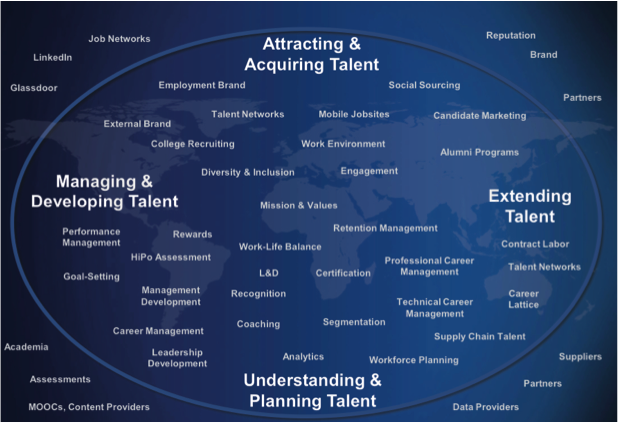
Optimizing will be the emerging trend that leading HR professionals will be required to master. This is according to the leading industry report by Bersin on trends to watch in 2014. Bersin defines the four main areas that encapsulate the HR function.

These include Attracting and Acquiring Talent, Managing and Developing Talent, Extending Talent and Understanding and Planning Talent and as you can clearly see from this illustration, the programs that support each area are global, intersecting across all of the HR functions.

This approach is not like previous best practices, where the corporate talent systems were defined by modular rectangles and managed within silos. The emerging trend illustrates the key HR functions as part of a global infrastructure and the programs must be designed to engage the entire corporate talent system

The new HR approach will not be a one-size-fits-all.

It appears that companies have outgrown the “one-size-fits-all” plug and go systems, so better pay attention. Put on your consulting cap. This emerging industry trend will impact your company’s bottom line thus reflecting on your own career tenure.

Developing a set of integrated programs that work seamlessly and are customized to each the company’s global needs will force HR professionals to take a consultative approach. Bersin’s infographic does an excellent job laying out the variety of tactics HR needs to weave throughout the entire talent system.

When selecting new technologies, it is critical that HR professionals seek vendors who understand a tailor approach to optimizing the talent system.

Today’s talent growth hacker goes beyond the silos.

A growth hacker is a term that is being widely used in marketing to describe how successful startups use cost-effective tools like social media apps as alternatives to traditional methods of marketing like purchasing advertising in radio, newspaper and TV.

There are amazing technology tools now available to manage and grow talent networks. Any HR professional can be a talent growth hacker by implementing the features of some of the social media apps. Bersin’s infographic suggests LinkedIn, Glassdoor and Talent Networks as examples.

TalentCircles offers one single portal that brings together social media, email campaigns, online events, video interviews, chats and online content.

In the next post in this series, I will share specifically how HR professionals can benefit from some of the features that TalentCircles offers that help manage the entire life cycle of the talent system across the key areas noted in Bersin’s report.

Picture Source: Bersin by Deloitte, 2013

Jessica Miller-Merrell, SPHR is a workplace and technology strategist specializing in social media. She’s an author who writes at Blogging4Jobs. You can follow her on Twitter @jmillermerrell

Photo Credit

Tuesday, December 11, 2012

How to Overcome Obstacles in Healthcare Implementing a Social Media Program


By Jessica Miller-Merrell


As I mentioned in Part 1 of this healthcare social networking series, I see a great deal of opportunity in social networks being leveraged in the Healthcare industry.  Whether it’s building a relationship with future employees or current ones, social media technologies can be used to foster an employee and employer relationship that creates channels of communication instead of traditionally shutting them down. 

As an employee, one of my biggest frustrations with an organization was the feeling that no one was listening.  With social media the conversation and engagement is always flowing and organizations can use Big Data to help uncover employee or candidate trends and employee trends that help refine and support our current workplace communication efforts. 

Healthcare like Finance are two of the highest regulating and monitoring industries making organizations slow to adopt social media.  I see obstacles as an opportunity for competitive advantage because if everyone was doing something, it wouldn’t be as effective.  And we’ve already seen that social media is still relatively new to Healthcare from the 2011 Deloitte Report with 14% of U.S. hospitals using social media and social networking as an external facing marketing and communication tool. 

Chances are you have an interest in using social media at your organization.  Maybe it’s working with Talent Circles and building a talent network to create a candidate experience and community your organization owns and can source from.  Or maybe you are looking to make a case for launch an internal communication network using platforms like Yammer, IBM Connections, Jive, or Chatter.  Whatever your reason, developing the dialogue with senior management and overcoming corporate hurdles can be over half the battle. 

HIPPA Privacy Concerns

HIPP is a common obstacle for anyone wanting to communicate in the healthcare industry.  Communications between health care providers and their patients are subject to the Health Insurance Portability and Accountability Act (HIPAA), which limits insurance plans, hospitals and physicians from answering questions on a specific patient’s health information across a social network.  Concerns like this don’t impact an external talent network as the large majority of community members are potential employees who do not have access to patient records.  Talent network members who are company representatives can be easily controlled and monitored. 

One of the benefits I see to establishing an internal social network is that information, messaging, and conversations unlike traditional social networks like Facebook, Twitter, and LinkedIn are kept in house.  Organizations allow for a place of discussion like the break room water cooler making it less likely employees will share opinions, patient information, and other news outside of the internal social network. 

Establishing a Cost Baseline

One of my favorite ways to get executive buy in for a project like leveraging social media is to launch a pilot program where the risk is minimal, participants are hand selected, and we establish a 90 day window where the new program is tested before being implemented on a larger scale.  This helps us determine the real cost, change our approach based on the pilot, and determine the cost baseline for the project. 

Company executives are much more comfortable piloting a program first and dipping their toe in the water.  For many executives, social networking is still considered a fad.  By demonstrating the business case for social media beyond traditional marketing and communication, you can show them real value. 

Resources

According to a Greystone report, two-thirds of surveyed hospitals have not developed a plan on how to use their existing social networking sites and 70 percent of hospitals have less than four people devoted to social networking.  Maybe your organization has tried to launch a social media program in the past with mixed results.  Chances are your recruiting and human resources teams are already using social media in small amounts.  Whether it’s job distribution using social media or sourcing on LinkedIn, these are HR-focused social media activities, and my opinion is that your external recruiting network and your internal social network projects should be developed, executed, and maintained by HR.  Be prepared to discuss time commitments and who is responsible for the development and continued management of your social networking program. 

Overcoming obstacles when establishing your social networking program at a healthcare facility, hospital, or wherever is not easy.  With a little preparation, research, and planning you can implement a customized community that dramatically impacts your organization’s bottom line. 


Read Part 1 of our Healthcare Social Networking Series.

Jessica Miller-Merrell, SPHR is a workplace and technology strategist specializing in social media.  She’s an author who writes at Blogging4Jobs. You can follow her on Twitter @blogging4jobs


Wednesday, December 5, 2012

Social Networks Drive Innovation, Recruiting Efforts & Collaboration Especially in Healthcare


By Jessica Miller-Merrell


When it comes to social networking sites like Twitter, Facebook, and even LinkedIn big brands are using them to connect, engage, and build relationships with consumers, end users, and raving fans.  Even the healthcare industry has gotten the social networking bug using Twitter to update patient’s families and even YouTube to share patient care and experience stories. 

Study Shows Doctors, Nurses, & Hospital Employees Use Social Media 


A study released by Deloitte in 2011 found that more than 700 of the U.S.’ 5,000 hospitals have a social media and social networking presence to enhance their ability to market and communicate to stakeholders.  So why wouldn’t it make sense for one of the most competitive and fastest growing industries to dive into using social media to help fuel their healthcare recruitment and employee retention efforts? 

Interestingly enough in that same Deloitte study, sixty percent of physicians surveyed and 65% of nurses are interested in using social networks for professional purposes.  Positions like doctors and nurses are very much in demand and often times the a very specialized position vacancy can impact the hospital, department, or healthcare organization negatively costing them two to three and half times the open position’s salary. 

Internal & External Social Networks for Healthcare  


Social networks are used by organizational including healthcare traditional two different ways:  1) Internal or 2) ExternalInternal social networks serve as an internal Facebook that is customized, hosted, and monitored by the hospital allowing for news, information, collaboration, and resources to be shared.  External social networks are those outside of your company portal and are outward facing.  These often overlap with many of your current marketing and patient engagement efforts except these conversations are centered around either information for current employees or career resources and job information to build relationships centered around the employer brand

Chances are many of your communication tools and resources are already available online.  Maybe it’s the hospital portal or an online-shared drive to store files, documents, and important spreadsheet information.  Internal social networks can do all those things just like your portal, but one thing is missing, the engagement factor.  Learning and relationship happens with communication, banter, and a back and forth between professional colleagues, peers, and friends.  We learn, grow, and absorb making us enjoy our work even more because we like and are learning from the people we are working with.  And because we enjoy our job and friends, we are engaged, productive, and active employee who plans on staying gainfully employed at your hospital or healthcare facility.  

Take Ownership of Your Candidate Pipeline & Talent Network 


One of the challenges of traditional external facing social networks is we don’t own or control the future of the community or the direction of the company where we have spent time, money, energy, and effort to grow that network.  Sites like Twitter, Facebook, and even LinkedIn own the data and control the information much like traditional resume mining job board systems leaving recruiters and HR teams at the mercy of the network.  While these systems are important to share job openings and for relationship building, organizations should take heed and continue driving their candidates to resources hosted within their own website or career page. 

While HR teams and recruiters are always hiring and on the look out for good talent, these special relationships need to be further developed, evaluated, and fostered outside of a traditional hiring system or software like the ATS (applicant tracking system).  This is where I believe a talent network comes into play and offer an invaluable opportunity for nearly any industry but especially healthcare to build a candidate pipeline that fosters candidate relationships and anticipates hiring needs before they actually happen.  

Check out Part 2 of our Healthcare Social Networking Series. 

Jessica Miller-Merrell, SPHR is a workplace and technology strategist specializing in social media.  She’s an author who writes at Blogging4Jobs. You can follow her on Twitter @blogging4jobs


Tuesday, November 20, 2012

Build an Employer & Personal Brand with the Share Economy


By Jessica Miller-Merrell


Knowledge and Information is Power in the Share Economy

Back before the Internet, information was power.   Knowledge and information was hoarded and dispersed in small quantities in the early days through oral storytelling and much later Benjamin Franklin and the use of the printing press. I think back to 2006 before the Internet and social media was king.  Information and knowledge was hoarded not shared especially in HR and Recruiting.  I spent hours piece milling and researching recruiting tools and sources to hire, source, and engage on.  Forums and chat rooms like ERE and HR Talk were places I frequented asking questions, establishing relationships, and learning about the industry.  Trying to break into this industry was tough and best practices and sourcing secrets were not shared as they provided a competitive advantage certainly not on a blog, webinar, white paper, or free online resource.  All that is no more with the Share Economy

How to Leverage Talent Pipelines with Influence

With technology and accessibility of mobile, the Internet for individuals at work, life, and school the knowledge model has been flipped on its head.  The share economy now drives influence, power, and success starting with the Internet and now moving toward the world of social media.  Companies can leverage the share economy and the talent pipeline through building talent networks and growing their employer brand. 

Long Term ROI with Relationship Marketing in Recruitment Strategies

With the share economy, he or she who has the biggest network wins and provides the greatest value to your community or sphere of influence.  The Share Economy drives candidates, employee engagement, talent networks and more importantly relationships for the long term.  That’s what makes the Share Economy so important.  It’s a long-term play that helps build influence, relationships, and drive the industry or your area of expertise through information, news, and great conversation. It’s a long-term recruitment strategy play that requires focus, patience, and experience to make it happen.
What are some ways you are using the Share Economy to build relationships in HR, Recruiting, or engaging job seekers to build your employment brand?  I’d love for you to weigh in the comments.  
Jessica Miller-Merrell, SPHR is a workplace and technology strategist specializing in social media.  She’s an author who writes at Blogging4Jobs. You can follow her on Twitter @blogging4jobs