Talent Circles

Showing posts with label Kevin W. Grossman. Show all posts

Thursday, July 26, 2012

It’s time for a bold new approach to talent networks

By Kevin W. Grossman


That’s the way it begins – change – the movement from one state to another, from a static status quo state to a hopefully more progressive and productive state. Like moving from flat two dimensions to a vibrant three.

The change begins in small groups, the sharing of new knowledge of what can be done that hasn’t been done before and the return of that “change” investment. The new knowledge fills the room, some of it permeating each exposed pore, entering the bloodstream and flooding our brains with possibility.

I recently spoke with a smart group of HR and recruiting practitioners at the Northern California Human Resources Association (NCHRA) Santa Cruz Region Meeting. My presentation was on social recruiting but with a focus on talent networks, the long tail of recruiting and quality over quantity – of change and what can be.

Most of the attendees were from smaller companies in the Santa Cruz area, but what was striking (and not surprising) was the fact that when I shared some recent research on social recruiting that claimed over 90 percent of employers would be engaged in it this year, everyone looked at me as if I just said we’d be riding magical unicorns in the big screen release of “Everybody’s Doing It” in 3-D.

Of course the reality is that while about half the room confirmed they use LinkedIn for professional networking, sourcing and recruiting, only three had Facebook company pages and no one, and I mean no one, used or even understood what Twitter was.

Well, there was one attendee who said he kinda used it. Kinda.

We then discussed the realities – that half the room prohibited most access to social networks during work hours. One HR practitioner even proudly said her company banned Facebook and Pandora during work hours.

Oh, man. Don’t kill my music. Mercy me.

But no one balked at my from-the-hip truths (one recruiter in the room nodded away and winked at me):
  • There are a gazillion people on social media today
  • Recruiters do source and recruit using social media
  • Candidates do use social to search for jobs
  • Companies are still mixed as to recruiting value

Companies are still mixed as to the recruiting value of social, which is why I’ve been thinking a lot about online talent networks this past year, writing about them, interviewing various HR and recruiting practitioners and vendors about them, speaking about them, dreaming about them (yes, really), and living and breathing inside one in particular – TalentCulture’s #TChat. (You should’ve seen the looks on the NCHRA attendee faces when I explained Twitter Chats.)

Much of social recruiting and talent network mainstream as it stands today relates to recruiting new employees for a company, but they can and should also form inside of companies with existing employees, and alumni, and their networks, both inside and out — a mass of hub-and-spokes circles within circles within circles that we only dream of maximizing return on.

Most everyone in the meeting agreed that the three-dimensional “unicorn” in the room is the fact that a talent network is only a network when those who belong collaborate, commiserate and connect with one another regularly for what can amount to infinite combination of reasons – but not necessarily applying for jobs outright. This of course can happen in existing social networks, other platforms and software systems that help create talent networks, and combination of all in between.

But the most common reality is that we usually end up with a two-dimensional network model, sourcing active candidates from a smattering of job postings and creating a database of people where occasional, hopefully relevant company and job information is shared with them. There’s just no true “network” inside.


Other kids may be running around and around the sandbox, but for those who are in it, for whatever time that is, it becomes an impromptu network where folks aggregate again and again. They’re not coming to the sandbox because you put it there. They’re coming because they want to play with the other kids and parents.

It’s time for a bold new approach to talent networks. It’s time for change.

What, you don’t know what a Twitter Chat is?

Thursday, July 19, 2012

Internal mobility and talent clouds

By Kevin W. Grossman


Mercy, it’s been hot in the Heartland. Scorching hot. Lawns-catch-fire-as-you-drive-by hot. If you live here or you’ve been paying attention to the Midwest drought news, the devastated crops and the meteorological heat danger advisories, you know what I’m talking about. We’re here on family vacation in the Quad Cities where two cities in Illinois and two cities in Iowa bookend the banks of the great Mississippi River.

I know; why would we vacation on the surface of the sun, even if it were by a river? Because of family, of course. And there’s lots of fun to be had, even with the heat. But last night what was more disruptive than the heat has been was the wicked thunderstorm that woke us all up and kept us up for a bit. Much needed rain in exchange for a sleepless night I guess.

For those of us in business today, there have been many sleepless nights over the past five years, and even with record profits and increased productivity for many companies, the qualified talent drought has only just begun. If we want to make it rain inside and out these days, we’ve got to be able to control our talent weather. More precisely, we must be able to understand the molecular makeup of our talent clouds, and how rapidly the combining and recombining of the molecules change the innovative power of our people, as well as scorch the very earth we work on.

Wouldn’t we rather predict our weather than be carried away in the perfect storm? Of course we would. That means having to look outward for talent sunshine, which is usually more costly in regards to attracting, recruiting, hiring, on boarding and training. Necessary depending on who and what you’re hiring for, but more costly.

What we need today need is talent insight on:
  • What happened before
  • What’s happening now
  • What will happen if I move the warm front to the cold front and back again
I’m talking about understanding who we have now who can then help later when we need them then, over here, and over there, and over there. This can include selecting from full-time, part-time, temps, contractors as well as your own customers, partners and competitors.

Internal mobility has been mixed blessing for many organizations because although many would prefer to hire and promote from within, if they don’t have the right insight on their employees and teams, then it becomes difficult making those decisions, especially in such an interconnected global economy, with hot job markets only in specific sectors like IT.

Of course we can open up our position searches to internal folks and compare and contrast them and then hire/promote the most qualified, but that linear thinking doesn’t help when it comes to understand how our internal folks work individually, together, what their value is combined and recombined, and how they impact our business.

In the smaller organizations I’ve worked in, it’s easier to orchestrate our talent clouds. But in larger ones it can become the cliché of the resume database that stagnates like pooled rainwater that then breeds only mosquitos, not mobility. Talent network platforms that can send out virtual weather balloons and forecast where you are and where you’re going – combined with progressive talent acquisition processes, people and systems – can give organizations the tools and resources to better orchestrate their talent weather, although we all know how glacial change management can be. And you can’t always have just-in-time sunshine if you don’t control the talent clouds.

All right – enough with the weather metaphors. Internal mobility done right with talent network insight can help give you the competitive advantage in today’s global marketplace.

Friday, July 13, 2012

Business Talent Networks: The Coming-of-New-Economic-Age Story


In the quirky yet poignant coming-of-age movie Moonrise Kingdom, every single frame of film is like a lovely picture-box where the forced perspective of people and imagery is slanted outward toward the viewing audience, inviting you into every second of every scene. It’s fascinating really. Thousands of film frames, these celluloid picture-boxes, collaborating one after the other to deliver a unified story for all to experience and hopefully enjoy.

But today our intertwined personal and professional lives are fast-forward fragments of these forced perspective stills. We live in snapshots of jobless recoveries and economic downturns and employee dissatisfaction and too many unqualified applicants and business uncertainties and one size fits all no matter how much some blather on incessantly about adaptability and globalization...

These pictures aren’t quirky or poignant or pretty. They’re literal clichés from today’s world of work that doesn’t show much for tomorrow other than flat two-dimensional black and white stills. However, consider this from a recent BusinessWeek article:

From March 2011 to March 2012, [John Deere] customers ordered more than 7,800 different configurations of the 8R. On average, each configuration was built only 1.5 times. More than half the 8Rs were built just once, for a single customer. Thus, the global tractor: One size does not fit all, from Kansas to Kazakhstan.

Yes, John Deere. The riding mower and tractor company somewhere out in the middle of nowhere. The $32 billion dollar global riding mower and tractor company somewhere out in the middle of nowhere, that nowhere being somewhere my wife and her much of family are from. The Quad Cities of Illinois and Iowa right smack dab on the banks of great Mississippi River, America’s heartland, where we’re going soon for a family vacation. Moline, Illinois, to be exactly where John Deere is headquartered. (The picture is my oldest daughter wearing a pink John Deere hat a few years ago.)

Again, that’s 7,800 different configurations on big hardware where each configuration was built only 1.5 times. A true America icon still shining brightly after 175 years, adaptable and global and growing and hiring. This is not the hip and fresh gig from Silicon Valley and the Bay Area and the startup capital of the world, San Francisco. But it’s just as important to the U.S. economy as well as the entire world.

If a large historic business institution can create lovely picture-boxes of innovation and growth, then so can other companies. We don’t have to be stuck with fragmented and bland world-of-work imagery. We can actually create business talent networks of executive management, employees, alumni and applicants who can come together and collaborate, sharing a dizzying array of configurations that give forced perspective a whole new, well, perspective. These vibrant images becoming one fascinating coming-of-new-economic-age story for all to experience, enjoy and thrive in, from the Heartland to hereafter.

Friday, July 6, 2012

A sweet career development meal for our military veterans

By Kevin W. Grossman


One in three. Mercy me.

According to the U.S. Department of Labor, one in three young military veterans were out of a job the last quarter of 2011. That rate was double that of their civilian peers.

Double, mind you. So much for economic independence day (that continues to still evade America and most of the world). Whoopee. Have some stale shortcake with those moldy strawberries.

And according to a recent New York Times article, “The unemployment rate for veterans of the Iraq and Afghanistan wars has remained above the civilian rate for several years, standing at 12.7 percent in May, compared with 7.7 percent among nonveterans. The problem is particularly great among younger veterans ages 18 to 24, whose unemployment rate was 23.5 percent in May, 10 percentage points higher than their nonveteran peers.” That’s not accounting for those who have partial employment or those who have given up all together.

The disparity, as I’ve read over and over again of late, is blamed on the fact that matching military skills and experience to civilian jobs has been confounding to employers, of which I find confounding. With the exception of direct combat experience, all the skills learned in the military are critical for the private sector today — from technical skills to leadership skills to being an adaptable and disciplined a team player.

But why is it that so many employers are missing out on these highly trained individuals? It’s not that there aren’t enough skills assessments on the market: SHL alone claims to have over 1,000 titles and competitive prices. Plus, there are myriad of other assessment companies to choose from, allowing employers of any size to size up their applicants, albeit from the military or not. Not to mention the even minimally trained sourcers and screeners who should be able to match and translate experience to business needs. Literally matching keywords from resume to job posting does not a meal make.

We’ve got “bleeding edge” recruiting technologies to help us sort through the candidates, which for some companies could mean hundreds of online applications each week. However, as I’ve written before it can all be like an Escher maze, the social networking pages to job boards to career sites to applicant tracking systems that are as endless as the miles and miles of back road we travel everyday, where we are in fact loosing qualified passengers along the way, not to mention the gastronomical unmentionables we find along the way.

We keep measuring the cost of a bad hire – thousands and thousands of dollars per bad hire depending on the level and position. But we’re not spending enough time evangelizing the return of making a good, tasty hire. These good hires are the employees who make our businesses thrive and grow; they know who else around them, above them and below them are making things thrive and grow, like fresh yeast activating flour, salt, water and eggs. They know who has had previous military experience and who doesn’t.

Why aren’t we facilitating a “platform” mixing bowl in which these thrivers and growers can show us directly how and why their recipe works? We don’t want to stop our top team members and leaders in their tracks, but we do want to watch in real time their interactions with one another. And if you’ve got anyone with previous military experience, find out why were they hired in the first place, and if they’re performing, add another why on top of that. If you haven’t hired anyone from the military, figure out that why as well.

It’s up to the people acquisition and management folk – recruiters, human resources, hiring managers, project managers, executive management – to identify, analyze and extrapolate what skills their best talent has and then examine their origins to create better talent mapping techniques. An internal talent network recipe makes for the right dish that sticks to your ribs. You can source, screen, assess, interview, identify, map, sprinkle in a dash of salt and pepper –

Nothing says Independence Day like a sweet career development meal for our military veterans. Invite them over to your house soon, and don’t forget the fresh whipped cream.

Saturday, June 30, 2012

Uniting Open Networks and Hierarchy in Talent Networks


"We can walk our road together
If our goals are all the same.
We can run alone and free
If we pursue a different aim.
Let the truth of love be lighted,
Let the love of truth shine clear.
Sensibility, armed with sense and liberty,
With the Heart and Mind united in a single perfect Sphere."

--Neil Peart, The Sphere: A Kind of Dream

Again with the Millennials and Generation Y. Those were the first words out of his mouth and I immediately became polarized to my previous points of Generation Now.

The ones about treating everyone non-generationally and talking with them straight. That being passionate about what you do is one of the most important tenets of the world of work, ever, regardless of when you were born. That today we’re not only loyal and committed to the work that moves and schools us, but also to the people who are part of that committed work — because that’s the work that moves us to do greater things for the world.

That’s the work that makes it easier for startups to start up and for established companies to grow — creating new jobs and replacing some of those lost over the past five years, including full-time, part-time, flex time, contract, and project work, and any combination of those and more that you can imagine. That’s the work that transforms technologies, processes, communities, and the very heart and soul of the world.

At least that’s what thought at first listening to Malcolm Gladwell’s keynote at this year’s SHRM Conference & Exposition in Atlanta. Because he said, “Let’s talk about Millennials.”

But that’s not where he went at all. In fact, speaking of being “moved and schooled” in the end, I certainly was. No, where he went was talking about two generational differences that do exist – and should co-exist.

These are:
  • Hierarchy
  • Open Networks

What Malcolm explained so eloquently and intelligently is that we've gone from hierarchical, disciplined, centralized social organizations (think Boomers and Gen X) to collaborative, amorphous, organic, open social networks (think Gen Y and Z).

Which isn’t really a good or bad thing, because they’re two very different worldviews that have changed dramatically the way we participate in the world of work yesterday and today. On the one had you’ve got the traditional top-down management structure that according to Malcolm began to break down in the 1970’s when individuals began to demand more ownership over their career aspirations (and paychecks). And then on the tail end of my generation, Gen X, those born in the 1980’s and 1990’s found knowledge and power in the collective, their personal and professional social networks that upended the top-down structure.

But the amorphous nature of open networks versus the structured leadership of a strong few – the differences between the succinct success of Civil Rights movement and the oblique success Occupy movement in the examples that Malcolm shared – tells a tale of two separate states of mind and heart. However, when combined, it’s a force to be reckoned with. Think different. Think Apple – open social networks internally run by a formidable dictator and brilliant business mind.

Apply this strategy to your open talent networks, the ones made up of new candidates, current employees, management and the like – the ones you’re sourcing from for any position current or future. But manage the networks with structure and direction and sound leadership, however you decide to do it.

Embedding hierarchy into open networks makes for magic, uniting hearts and minds. That’s what truly transforms technologies, processes, communities, and the very heart and soul of the world of work.

Friday, June 22, 2012

Three Types of Rest Stops to Consider Along Your Talent Network System


The U.S. Interstate Highway System construction was authorized in 1956 by the Federal Aid Highway Act. Over 55 years later its network extends nearly 50,000 miles of highway and about one-quarter of all vehicle miles driven in the country use this system. Add to that thousands and thousands of miles of other byways and bad roads and you’ve got a lot of driving going on.

Along the way there are a myriad of rest stops, fast food restaurants, gas stations, hotels and motels, run of the mill and eclectic points of interest – you name it. Along most major thoroughfares you’ll find plenty of places to stop and “refuel,” but there are times where there’s a whole bunch of nothing and you better be sure you’ve got enough fuel in “all tanks.” Add to that extreme hot and cold weather, accidents and commute gridlock and you’re along for one helluva ride.

I took a road trip this week to see my best friend in Chico, CA. I know the route well, as a collective group of friends and I from high school have made the journey every year since my friend moved here in 1989. Not so much in the past few years with all of us getting older and life getting more complicated, which is why my trip was overdue.

The highways and byways are a means to an end; we’re not driving them for the journey, just the destination. Most of the time at least, unless it’s a first-time vacation road trip experience – like your first true job hunt. Or even the next one, or the next one…

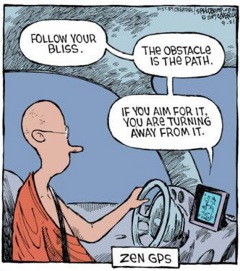
Like an Escher maze, the social networking pages to job boards to career sites to applicant tracking systems are as endless as the miles and mils of roads we travel everyday. Most career search drivers just want to get on and off, and yet we don’t really help them do that; we don’t provide them with a Zen-like GPS so they can get to where they’re going to and apply for that dream job. You know, the one advertised on the big, religiously gaudy billboards along the highway – “Jesus is really sorry about the candidate experience. Have some fries and a Coke. Or a Pepsi.”

I recommend that employers really think about the experiences they’re creating for job candidates, that they should travel the same roads themselves to experience them first hand.

Did you get lost? Get a flat tire? Engine catch fire? Stuck in gridlock? Did you get a ticket? Did you get flipped off by someone you cut off? Did you flip someone off who cut you off? Did you find a rest stop along the way? Did you ever get to where you’re going to?

Once you’ve done that, then consider these three types of rest stops along your talent network systems:
  1. You don’t need rainbows and unicorns along the side of the road while they apply, but you do need to give those candidates wanting to apply easily and efficiently the courtesy of the path of least resistance. Reduce the number of clicks; these folks just want to apply for your jobs. Don’t make them do road work along the way. 
  2. But oh, do have periodic rest stops for those who need to pause for whatever reason – and give them glimpses of your company culture in between. Meaning, if I apply and then take a break before I complete an online assessment, keep selling me as to why I want you to apply in the first place and why you should be working here. Give me a reason to come back and finish, entice me, don’t make it a chore just because I have to stop and go pee. 
  3. And lastly, for the smaller percentage of candidates who want to take more time to get to know you and others, both outside your company and your current employees, give them fun-land rest stops complete with collaborative refueling stations, gaming options, testing centers, white boards to share insights, virtual face-time communications across networks and whatever else you can think of to have them get to know you and vice-versa. Give them the opportunity to shine when they want to make the time and stop.


That is all. Happy driving!

Thursday, June 14, 2012

Recruiting still lost in an Escher maze

By Kevin W. Grossman


She took the microphone, paused, then asked, “So how do I get noticed when I apply to a company online and my resume goes into an applicant tracking system with dozens of others competing for the same position with similar qualifications and keywords?”

She feigned a smile, held the mic at half-mast and then handed it back to me. Not just dozens of applicants, I thought, hundreds if not thousands. Not matter how she served herself up, no matter the keywords used and embedded throughout her resume and online profile, she’ll still most likely get lost in the proverbial black hole.

This particular candidate experience has been written about more than most, and unfortunately hasn’t changed much over time. My recent experience volunteering to speak at Hirewire, a local organization to help job seekers in Santa Cruz County with career development and job search advice, verified this sentiment from the woman above as well as over 20 others who attended the monthly event. Multiply that across similar gatherings in municipalities all over the U.S.

According to a recent HR Executive article titled Not Ready for Recruiting, we’re still not improving. In fact, in the 2012 Allied Workforce Mobility Survey from Allied Van Lines highlighted in the article, found two-thirds of 500 HR professionals polled saying they have "extensive" or "moderate" plans for hiring this year, and 80 percent of larger companies – with more than 10,000 employees – plan for "extensive" or "moderate" recruiting. And yet, 52 percent of those respondents consider their recruiting programs to be only "somewhat successful."

Ho-hum, diddly dumb.

Complicate that with the highly competitive IT job market. According to a TLNT article, 83 percent of startups from a Silicon Valley Bank survey said they’ll add IT staff in the next year. But, a Dice survey says that despite the growing competition for tech talent, getting professionals to jump ship isn’t easy. Only 37 percent of the surveyed managers say their voluntary departures have increased this year.

A big disconnect that relates to all this is the fact that although many companies have made progress in creating initial quality user-experience career sites, when it comes to actually applying for the jobs, it’s like trying to traverse an M.C. Escher drawing where you end up where you never started from.

Recruiting is getting more complicated than ever and it’s amazing to me that companies aren’t making the candidate experience any easier to explore career opportunities – and this means new candidates as well as internal candidates. Sourcing, recruiting, hiring and retention should be highly collaborative activities, and yet we’re truly still lost in an endless Escher maze, losing quality hires and internal moves along the way.

Friday, June 8, 2012

The art of experimenting: Talent network Petri dishes help screen for balance

By Kevin W. Grossman


When the numbers are in the trillions – 10 trillion to be precise – a lot can be accomplished. But then again, a lot can go wrong as well.

The human body is made up of 10 trillion cells, the building blocks of life. That means the exponential number of cellular interactions and chemical reactions are nearly endless. A lot of amazing things can happen along the way with the human body’s ability to adapt and flourish, and as modern biology has shown us, a lot can also go horribly wrong.

Cancer has been used as a metaphor for a long time, but it’s vile destructive path both literally and figuratively unfortunately never wanes, never lacks a heart-wrenching, shake-your-head story. Organizations get cancer; individuals get cancer. My father has been battling melanoma that has now spread throughout his body, and most likely anything the doctors do will only prolong his life for the short-term, adding months instead of years. It’s a difficult time for our family, which is why those who have been through it vilify cancer and other diseases of cellular failure.

But there are lesser dysfunctional evils that affect those trillions of cells, and those can actually benefit the literal body in an evolutionary way as well as the figurative body in a world-of-work way. However, the irony is that we talk so much about the progressive global workplace of today when the most of the world is still pretty suit-and-tie conservatively corporate and women still struggle to be seen and judged as individuals. And while on the one had we argue the ethical, medical and spiritual pros and cons of DNA cloning and genetic engineering, the other hand wants to clone and hire cookie-cutter employees based on bland job descriptions that don’t allow for coloring outside the lines.

Again, the cellular dysfunction isn’t all so bad. According to a recent article in The Economist:

“Julie Login of Cass Business School surveyed a group of entrepreneurs and found that 35% of them said that they suffered from dyslexia, compared with 10% of the population as a whole and 1% of professional managers. Prominent dyslexics include the founders of Ford, General Electric, IBM and IKEA, not to mention more recent successes such as Charles Schwab (the founder of a stockbroker), Richard Branson (the Virgin Group), John Chambers (Cisco) and Steve Jobs (Apple).”

The great captains of industry suffer from synaptic connections gone haywire. And mercy look at what’s it’s gotten us via some pretty happy and successful accidents. That doesn’t mean they’ve need polarizing balance on the other side with sound management and front-line folk, but it does mean some of these cellular interactions and chemical reactions have been good for innovation and business.

Organizations think they can’t experiment with talent screening for new and existing employees in their own Petri dishes, but they actually can, and that’s in the form of talent network petri dishes. A place where applicants and employees alike can communicate with one another, collaborate with one another, commiserate with one another, and the “mad” scientists – the HR, recruiting and hiring manager scientists – can witness in real-time the interactions of who does what with whom when, why and how.

Throw in some controlled experiments (scenario-based experiments, problem-solving, individual and group assessments), and the talent network petri dishes give insight as to future brilliant “dysfunctionals” who innovate and those who will keep them balanced for business growth in kind.


Wednesday, May 30, 2012

The contextual quality of content is what births talent networks

By Kevin W. Grossman


Fascinating. The fact that there are legions of fetal cells that hang out inside a mother for decades after she gives birth – and that they might even help heal her when she's sick or hurt.

But whether they hurt her or not isn’t as simple as it seems, according to research by Dr. Kirby Johnson at Tufts University, which I learned about from a recent Radiolab podcast. At first, when Kirby and his team were analyzing the data, it seemed as though (and they romanticized as such) that maybe the fetal cells were actually helping healing the mother’s liver infection, or bladder infection, or whatever ailed her.

Not the case – in fact, sometimes they fetal cells were actually attacking the Mama’s organs and cells. (The Mama is what I affectionately call my wife, the mother of our lovely two little girls.) There are lots of variables that, depending on context, change the impact on the Mama.

The research continues, but it got me thinking, and you knew that was coming, about how the Mamas in your world of work and recruiting – your company career site, your company referral program, your online social networks, your talent network service, your applicant tracking system – how all of these give birth to your new employees.

Then even after new hires are birthed, there are those fetal cells that remain, meaning those who you didn’t hire. Except now they stay to be healed in a sense, not to heal, and they’ll leave to hurt if there’s no reason to stay (think slamming you on social media, Glassdoor, Vault, etc.). Whether or not they do stay to be healed, well, that all depends on a lot of factors that are based on content and the contextual quality of that content.

For example:
  • How much of your true company culture is revealed?
  • How much relevant industry content is shared?
  • How much career development advice and resources are given?
  • How easy is it to learn about other jobs they may qualify for and to apply for them?
  • How easy is it to collaborate (and commiserate) with others who have stayed, including those birthed and hired on?

There are many more examples where those came from, but the fact remains that if you want to improve the candidate experience for all who linger and long to be hired, then it’s the contextual quality of content that births those talent networks.

And heals them.

Monday, May 21, 2012

Catching talent! We should expect more of portable and flexible in the world of work


That’s why I downloaded it. So at some point I could join a online meeting or webinar remotely, from the comfort of my own iPad.  

And that’s all I wanted to do the first morning of the Recruiting Innovation Summit this week, to join and run an important online meeting from the comfort of an armchair in a hallway adjacent to the event. This is a popular virtual meeting product that I assumed wouldn’t have failed – but it did. I tried five times to join that friggin’ meeting, and each time it failed.

I’ve seen a lot of apps – both native and browser-based – and I’m still amazed at the seemingly lack of effective user interface (UI) testing. I’m sure you’ve heard various iterations on the phrase, “If you don’t use it, you’re gonna lose it.” And if your users don’t use it…well?

To be fair, lots of technology companies, including those in HR and recruiting, have some level of UI proficiency on their product development teams. But again, all I wanted to do was join and run a virtual meeting, and I couldn’t.

Just as busy, progressive professionals want to take their online profiles with them wherever they go, the same folk want to (and do) take their virtual offices with them wherever they go – that’s the kind of world we live in now. It’s an evolution of sorts, the world of work pushing us to be “on” at any time, dialing it up and down as needed, and us pushing back, dialing it up and down as needed. This includes seeking out and exploring new job opportunities.

A growing contingent of professionals expect portable, expect flexible, expect a more diverse world of “easy buttons” that actually work. Here’s a juxtaposition though – when asked at the summit whether or not the attendees have a mobile-optimized career site, only about 2 of 200 raised their hands. 

Make it easy for talent to signup at talent fairs using Talent Catch!

Add to that the fact that according to Gerry Crispin and the Candidate Experience Awards research, only a little over 50 percent of companies have applied for their own jobs online.

What if I wanted to hit a hallway adjacent to an event I was attending and have a quick interview with a recruiter? Or even just simply finishing applying for a new role via a social referral I received? Or join a talent network via simply clicking on “Connect with Facebook” or “Connect with LinkedIn”?

What if indeed. We’ve only just begun.

Friday, May 11, 2012

Strategic choice: Create and nurture nimble talent networks


How refreshing it was to hear it. Not that I disparage LinkedIn as a valuable sourcing service; it is used by more recruiters than any other online network. But for the first time of late I heard a recruiter at a decent-sized company lauding the use of Quora to source and network, not LinkedIn. Quora is an expert network where questions are posed and answers are given about a variety of topics from a variety of industries.

That’s one of the biggest wins when it comes to recruiting these days – being flexible, nimble and opportunistic. Finding where your target talent is and going to them. Then creating talent networks and nurturing them, on their own ground as well as yours, whether you hire them or not.

This is a critical key to hiring and retention and one of many valuable takeaways from the recent San Francisco event War For Talent, Winning the War for Startup Talent. And what an appropriate place to have the event, since San Francisco is the center of the startup universe these days (and the past few years).

Blech. War for talent? I know it’s a highly competitive marketplace for the highly specialized skills needed today, especially those needed for technology startups. According to economists quoted in a recent Bloomberg Businessweek article, “Job growth since the end of the recession has been clustered in high-skill fields inaccessible to workers without advanced degrees or in low-paying industries.”

As I wrote recently, it’s not really a war; it’s a mobilization of innovation and motivated minds — the leaders, the builders, the doers, all the combined skills that make up the “startup” and of course the money that make it all happen, with barriers to business entry lower than they’ve ever been.

Take the opening keynote speaker at the War For Talent event, Ron Conway, co-founder of SV Angel. Ron talked about how recruiting and hiring should be the number #1 priority for startups, that these firms are the job creation engines.

He emphasized that anyone can be recruited at any time and referenced his time advising Mark Zuckerberg of Facebook. Early on Zuckerberg spent hours a day recruiting (still does) and was quoted as saying, “If you're not fatigued from recruiting, you're not doing your job. You should always be replacing yourself.”

In fact, a lot of companies are fatiguing their recruiting teams left and right, trying before they buy in today’s market (and trying to find before they buy). For example, developing internship programs and then sourcing whom they should really hire over time. Remember, many highly specialized skills are a rarity in hot markets like the Bay Area.

But even if you've got a great product and your growth trajectory is vertical, those are only table stakes in Silicon Valley and other markets. People want their minds blown to join a company – they want the emotional connection with everyone they’d be working with and for.

Recruiting industry thought leader Kevin Wheeler referenced this week in an ERE.net article that 2.1 million people resigned their jobs in February, the most in any month since the start of the Great Recession. He goes on to write:

“This is startling given that the economy is not strong and that millions are out of work. The natural inclination would seem to me to be to hunker down and hang on to the job you have, no matter how bad it is. That is what happened in previous recessions. Yet these were disgruntled, unsatisfied, and unfulfilled people who voluntarily, many without other positions or jobs lined up, chose to leave.”

Again, it’s the mobilization of innovation and motivated minds and the companies that are winning are creating and nurturing flexible, nimble and opportunistic talent networks.

Go ahead. Blow their minds.

Tuesday, May 8, 2012

People make it happen, not the resume

By Kevin W. Grossman


So, if you’re a vendor or consultant and you make this pitch, “Make sure your resume is ATS ready today,” I’m going to tell all the job seekers to run away, and fast.

Because making sure their resume is ATS ready today means you’re making sure it’s black hole ready. Today. And everyday like it always is when applying to jobs solely via career sites that go directly into applicant tracking systems.

That comment may get some calls, but hear me out. We’ve had this conversation before. Although I want the resume to die a horrible death, I understand that there’s still a huge part of the career management industry keeping them alive, making it better and making it work for you, the job seeker. To all my friends in this industry, please forgive me, as well as those in the talent acquisition space, as I also understand it’s probably not going anywhere for years to come.

But I still want the painfully ubiquitous resume to die a horrible death.

Why? Because it’s a self-serving piece of inconsistently formatted and fudged professional drivel that really doesn’t help me hire true quality of fit; it doesn’t help me make an emotional connection with my potential employees.

Knowing folks that already work here, and/or meeting and getting to know other applicants, employees, hiring managers, recruiters, HR pros and management in an online and/or offline setting – these are what make for stronger connections when looking for employment.

Resumes – or better yet, online profiles – are necessary when it comes to getting your skills and experience noticed, but as I wrote in my last article, it takes a community to retain an employee and it takes talent circles to create relationship-based hiring. And it does.

According to recent social media recruiting research from my friends at The A-List (which you can download here), employees hired via personal referral connections that include friends, family and across all social networks, have a much lower turnover rate than those who are hired through other sources. And social networking hires trend to higher job satisfaction and feel better informed about the opportunity prior to accepting a job.

Last week I was at the HRO Today Forum, and during the opening keynote panel, Where do Jobs Come From: The Birds & Bees of Labor Flows & Job Creation, one of the panelists – Scott Case of Startup America Partnership – enlightened the crowd with this bit of wisdom:

"It's people making this sh$t happen."

What he was primarily referring to was startups driving job growth, but I’ll take it a step further and say it’s people in talent networks and circles that make it happen for job seekers, not the resumes.

It takes a community and relationship-based hiring indeed.